Luxury Awnings: Designer Brands And Features

December 1, 2025

There’s a particular moment in every Singaporean afternoon when the sunlight stops playing nice.


It’s no longer “warm and golden”. Instead, it’s full throttle. The kind of heat that doesn’t just warm a patio but dares you to use it. And if you’ve invested in an outdoor space that’s meant to be lived in — not just gazed at through glass sliding doors — you’ll know that shade isn’t a convenience.


It’s survival.


But let’s not mistake basic shelter for sophistication. You’re not here to sling some discount canvas over your terrace and call it done. You’re here because you care about design, about durability, and about solutions that feel as good as they look.


You’re here for luxury. And not the performative kind — the thoughtful, quiet, actually-works-for-you kind.


So, what does luxury look like in the world of awnings? Not in catalogue-speak. In real-world, weather-tested, daily-use terms?


Let’s stretch this out.


It’s Not Just Shade. It’s Infrastructure.


Here’s the thing most people miss: a luxury awning isn’t just a fancy sunshade. It’s an architectural element.


It shapes how you live in your space. It’s not just about where the light lands, but where you eat, relax, and gather. Done well, it expands your home’s footprint in a way that feels natural. Done poorly, it sticks out like an afterthought while tanking the usability of your outdoor space.


In Singapore, where the weather is a full-time participant in your day, that usability matters more than ever. That’s why a “luxury” awning isn’t about gimmicks…


A luxury awning is about fit. Form. Function.


Fabric that holds its own under equatorial UV. Motors that retract silently and don’t throw tantrums after a monsoon. Mountings that still look sharp in year ten, not just month three.


You’re not just buying a product when you buy a luxury awning. You’re investing in how your space feels and flows, now and into the future.


Why Going Premium Makes Sense Here (Even If You’re Not A “Luxury” Buyer)

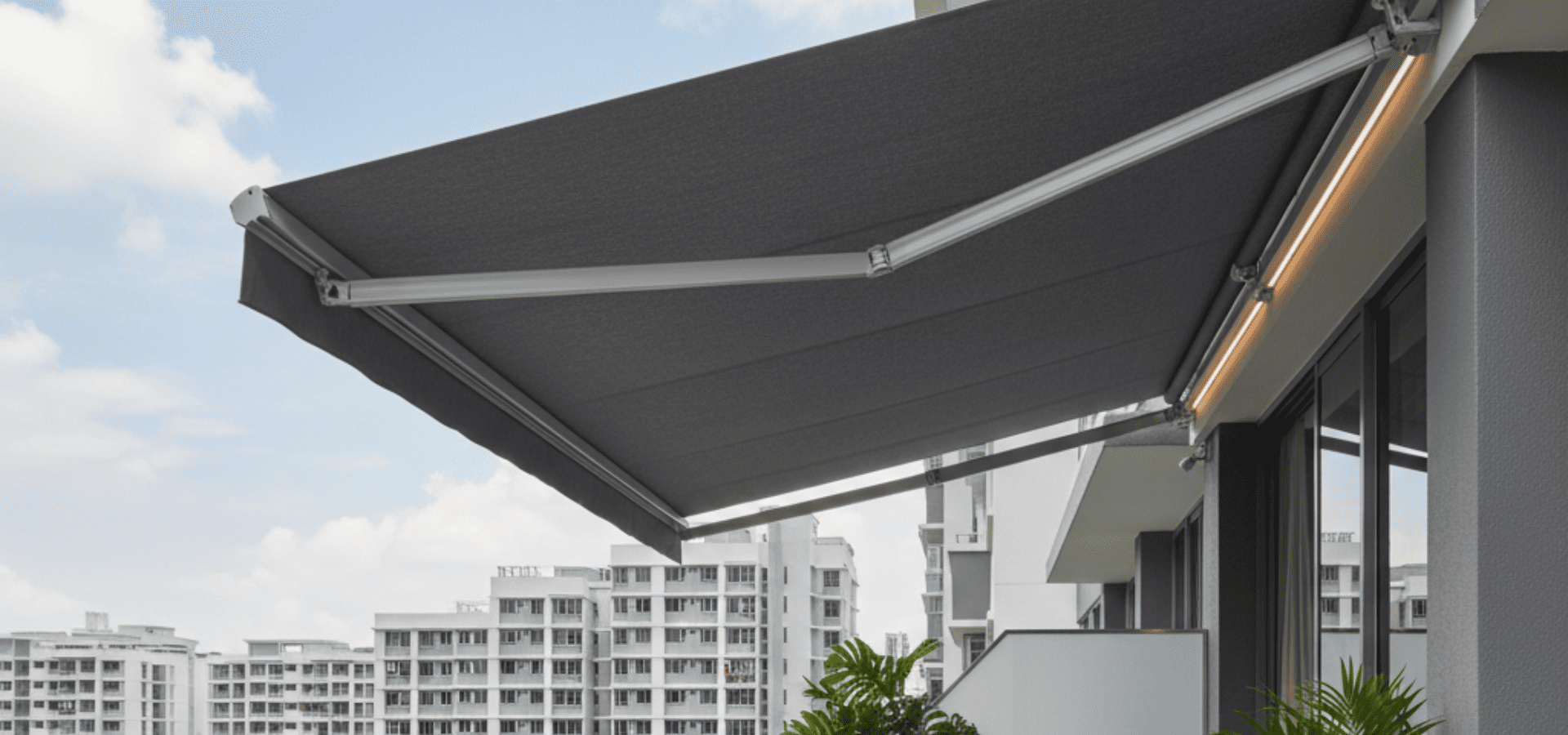
Luxury retractable awning at a condo in Singapore

Singapore’s weather doesn’t mess about. The sun’s intense, the rain’s sudden, and the humidity turns every surface into a test of endurance. Now factor in salt air if you’re anywhere near the coast alongside seasonal haze and heavy winds in certain districts, and the general wear-and-tear of being outdoors year-round really starts to stack up.


This is not the climate to cheap out in.


Basic awnings may get you through one season looking fine. But then the fabric fades, the frame starts to corrode, and the thing you thought was “good enough” becomes another chore on the list.


Premium awnings, on the other hand, are designed for exactly this kind of climate stress. They employ robust solutions to mitigate this issue:

  • Powder-coated aluminium
  • Marine-grade steel
  • UV-stabilised fabric
  • And even specialised motor systems that don’t blink at high humidity.


It’s less about prestige and more about staying power. In that sense, luxury is just smart engineering with better manners.


What Actually Counts As “Luxury” In Awnings?


But let’s be honest — the word “luxury” gets tossed around a lot. When we talk about premium awnings, it means something real.


It means performance that doesn't degrade, with a design that enhances rather than interrupts. Features are there to make daily life smoother (not just increase the price through added complexity).


You’ll know you’re in proper luxury awning territory when:

  • The awning disappears cleanly into a cassette, like it was never there
  • The motor responds without a grumble, even after a thunderstorm
  • The fabric looks just as fresh in year five as it did in week one
  • The whole thing operates like a quiet nod — not a shout for attention


It’s the kind of difference you feel more than you see. Like a really well-made, tailored, simple white shirt: nothing flashy, but damn, it feels good.


Brands That Know What They’re Doing

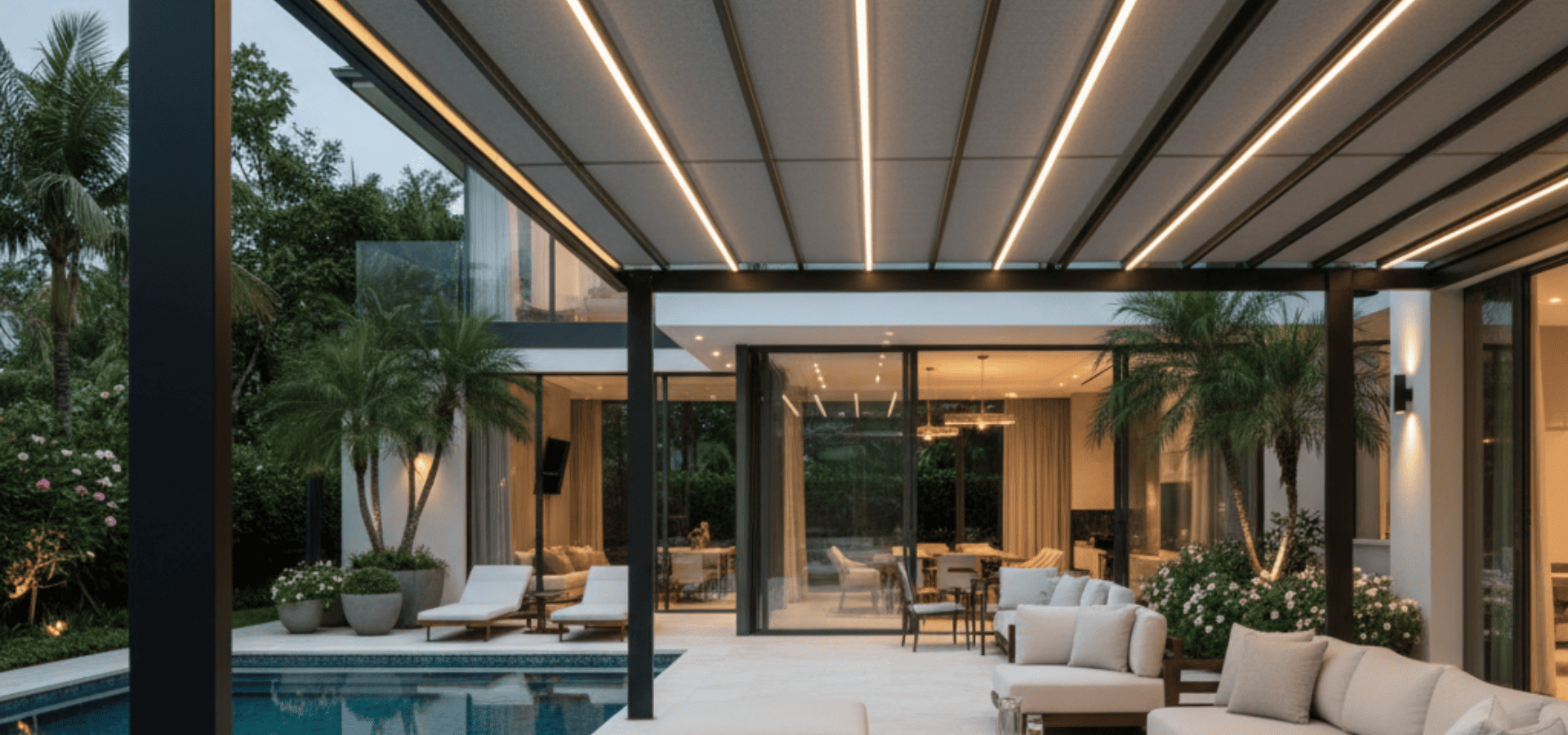
Luxury fixed awning beside a swimming pool in a luxurious home

Once you start looking past the generic models of awnings, a few names rise to the top. There’s no empty branding here either — only the brands professionals trust.


Architects spec these brands. Designers build around them. And homeowners who’ve used them once always go back for round two.


Markilux (Germany)


The poster child for refined restraint, Markilux awnings are precise, minimalist, and blessedly quiet. Their cassettes are so sleek they practically vanish into the wall.


Features like shadeplus (a vertical drop-down valance for low sun) show that these engineers understand living with weather, not just surviving it.


Warema (Germany)


If Markilux is about elegance, Warema is about control. Their systems are deeply customisable, with smart-home integrations that go beyond basic automation.


Wind, sun, and even rain sensors can be tuned to respond exactly how you like. It’s shading meets climate strategy.


Renson (Belgium)


More than awnings, Renson does entire outdoor ecosystems. Their retractables are just one piece of a bigger puzzle that might include louvred roofs, airflow panels, and modular pergolas.


But make no mistake: even their “simple” awnings feel architectural: angular, intentional, and timeless.


Corradi (Italy)


Design-forward in the way only Italians can pull off, Corradi builds shading solutions that feel like an extension of luxury hospitality.


Brushed aluminium, soft finishes, and enough options to satisfy even the most specific brief are some of the highlights of Corradi’s products. If your outdoor space is designed to entertain, this is your go-to.


Stobag (Switzerland)


Less flair, more function, but in the best way possible. Stobag excels in flexibility, offering a huge array of configurations for awkward spaces and custom builds.


Their tolerances are tight, their finishes are sharp, and their systems are engineered for zero fuss.


The Features That Matter (And A Few That Don’t)


Not all upgrades are created equal!


Here’s where your money should go. (And also where it probably shouldn’t.)


Must-Have Features In A Luxury Awning:


If you're splashing out for a top-tier awning, you can’t look past these features:

  • Full cassette housing: This keeps fabric and arms sealed away from rain, sun, insects, and pollution. In climates like Singapore, this is a non-negotiable.
  • Wind and sun sensors: These aren’t simple add-ons— they’re your insurance policy. Sensors will retract your awning automatically when conditions get risky.
  • Self-tensioning arms: A saggy awning is both ugly and a water trap. Self-tensioning arms keep the fabric crisp and taut, no matter how far it’s extended.
  • Integrated LED lighting: Dimmable, low-profile, and built into the arms or front bar, integrated lighting makes evening entertaining an effortless pursuit.
  • Smart controls: So while smart controls aren’t strictly a must-have, they are a big nice-to-have! App-based or wall-mounted, either way, the goal is convenience. You shouldn’t have to think about your awning once it’s set up.


Luxury Awning Features You Can Skip (Unless You’re A Gadget Lover):


Meanwhile, though you might encounter these upsells, you can mostly skip these features in an awning:

  • Heaters built into the frame: While these are great in temperate climates, they’re mostly unnecessary in Singapore unless you’re doing rooftop nights in the wet season.
  • Colour-change lighting: Fun? Absolutely. But will you use it more than twice? Probably not.
  • Overly complex automation: If it takes longer to set up than to use, it’s not elegant. It’s just homework.


Design, Customisation, And The Joy Of Choice


Luxury doesn’t mean cookie-cutter. In fact, that’s kind of the point!


With high-end awnings, you’re not stuck with a handful of beige swatches and two mounting options. You get real design agency.


Want a charcoal frame with a striped terracotta fabric? Go for it.


Need a projection of four metres on a third-floor balcony with no back wall? There’s a bracket solution for that.


Think of all the options you can fine-tune:

  • Frame colour and finish
  • Fabric weave, tone, and UV grade
  • Mounting style (i.e., wall, ceiling, roof rafter, or freestanding)
  • Motor type and control interface
  • Accessories (heaters, gutters, side screens, integrated speakers, etc etc)


It’s not indulgence: it’s design congruence. Your awning should complement your home and lifestyle — not clash with it.


Installation And Service: Where It Can All Go Wrong

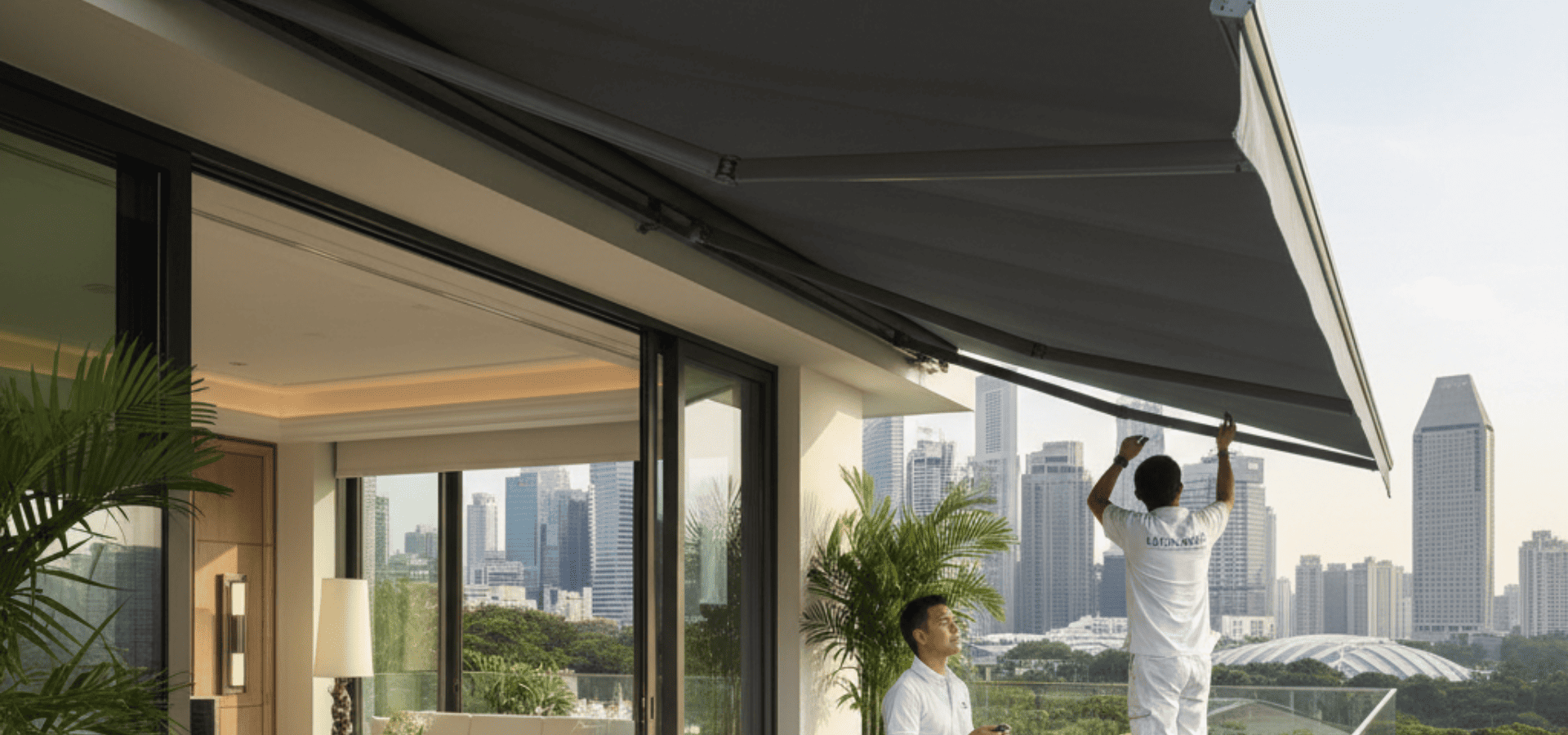
Luxury retractable awning installation by Uni Shades team

Even the best awning on the planet will underperform if it’s badly installed. In Singapore, especially with high-rises, variable weather, and complex elevations, your supplier needs to know their stuff.


When shopping around for awning contractors in Singapore, you want a team like ours. That means:

  • Certified installers who specialise in your chosen brand
  • Clear warranty terms — both product and workmanship
  • Post-installation servicing or tuning
  • Experience with smart home integrations (if applicable)


Don’t get lured in by showrooms alone. Always ask who does the fitting.


Luxury isn’t in the box. It’s in the outcome.


Final Word On The Final Shade


At its best, a luxury awning isn’t just a product. It’s a promise that your outdoor space will be as considered, as comfortable, and as climate-resilient as the rooms inside your home.


That promise matters. Because in Singapore, the line between indoor and out is always a little blurred. The weather is constant. The greenery is lush. And when your home flows properly from sofa to sky, you feel it.


So whether you’re sipping kopi on a shady balcony, hosting dinner under soft LEDs, or simply retreating from the afternoon glare, that awning overhead becomes more than shelter. It’s an enabler. A quiet luxury. The kind that works so well, you barely notice it’s there.


And that’s exactly the point.

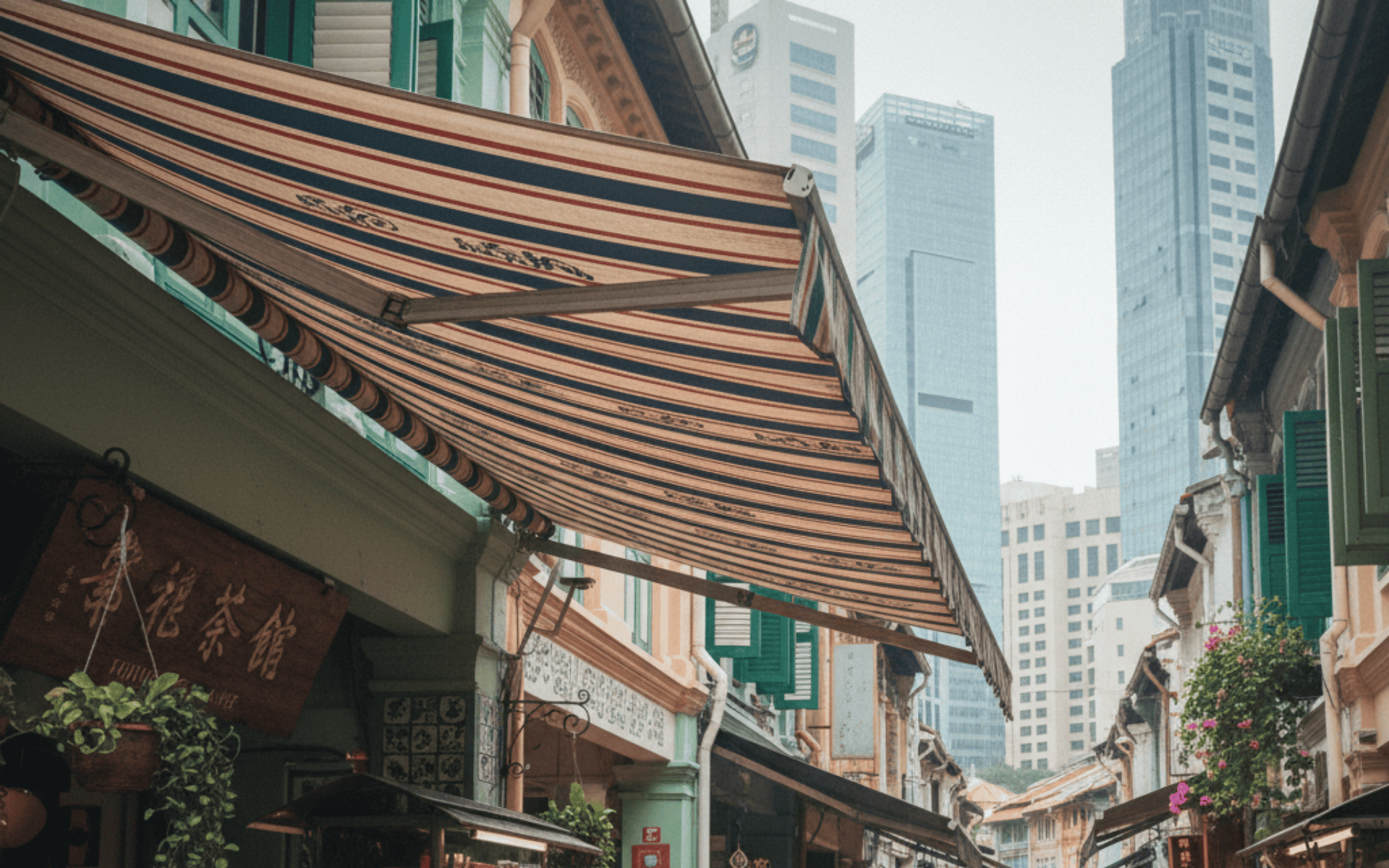
Retractable commercial awning in Chinatown Singapore
November 15, 2025
There’s something quietly transformative about an awning . One moment you’ve got an exposed patio or a shopfront baking in the Singaporean sun; the next, with a simple extension of fabric and frame, you’ve created a shaded retreat that feels worlds cooler. It might not be a new invention… But it is a redefined modern moment, all thanks to the humble awning’s mix of style, comfort, and energy-saving smarts. Still, for all their familiarity, a surprising number of people aren’t quite sure what counts as an “awning.” Is it just a canvas sheet? A fancy pergola? Something that only belongs above café terraces in Europe? In reality, awnings are a category of shade structure with a long history and an impressive amount of variation. They’re also particularly relevant in Singapore, where tropical sun and sudden downpours make adaptable shelter more a necessity than a luxury item. So let’s strip it back. What exactly is an awning, what options are out there, and why do people seem to love them so much? The Core Idea At its simplest, an awning is a secondary covering attached to the exterior wall of a building. Its purpose is straightforward… Provide shade and weather protection. That’s it. Most awnings stretch out horizontally, projecting over windows, doors, patios, or storefronts. They can be fixed in place, manually extended, or fully motorised with sensors and remote controls. The big difference between an awning and, say, a roof extension is mobility and scale. Awnings are generally lighter, designed for flexible use, and not meant to replace your actual roof. They’re an accessory, but one with teeth — easily capable of changing how a space feels and functions almost instantly. Awnings In Everyday Life
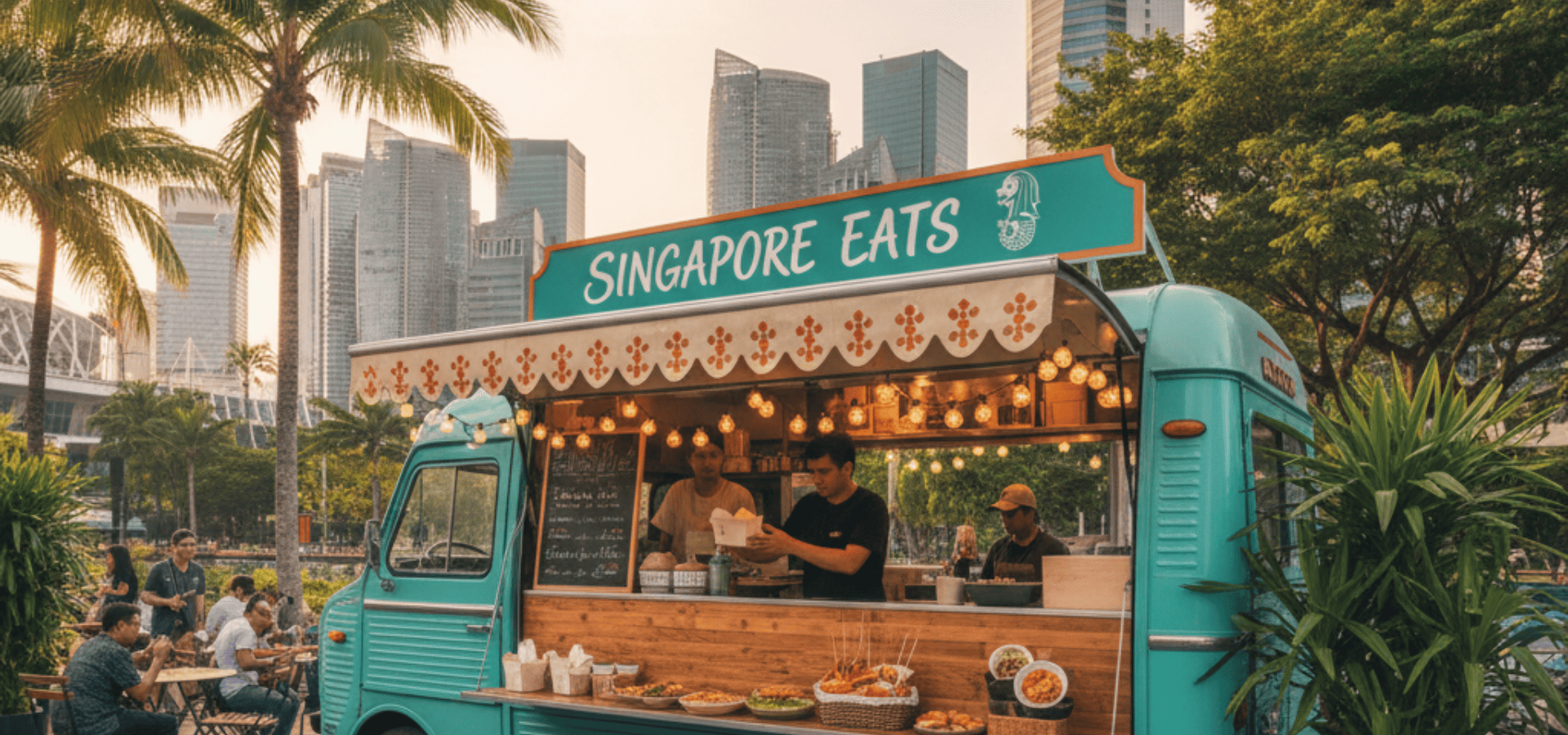
Retractable awning on a blue food truck in Singapore
October 1, 2025
There’s nothing glamorous about sweating over a hot grill while the noonday sun bakes down on your metal roof. Ask anyone who’s worked a food truck in Singapore: shade and airflow are survival tools, not luxuries. That’s where awnings come in. They’re not just decorative frills for your wagon; they’re working gear, as essential as your gas tanks or your prep bench. In the mobile food world, space is money, and comfort is oxygen. The right awning can mean the difference between a queue that lingers and a customer who decides that while nasi lemak is delicious, it might not be worth ten minutes of lining up in direct sunlight. Your staff don’t keel over from heatstroke by the lunch rush either. Shade sells, literally. Sometimes, it's the only thing that keeps service rolling. But awnings for food trucks are not quite the same beast as the ones bolted onto homes or cafés. They need to move, fold, fit regulations, and survive the uniquely tropical climate Singapore dishes out. This guide breaks down what matters and how to choose the right one, so you can focus on what matters… Keeping your customers happy and full. Why Food Trucks Need Awnings More Than Ever Mobile kitchens in Singapore don’t operate in air-conditioned malls. They’re in carparks, event spaces, park connectors, industrial estates during lunch — basically, anywhere a hungry crowd can gather. Shade is a crucial component of this setup, as essential as even the gas hookup. For customers, nobody enjoys queuing in a hot pocket. A well-angled awning creates a small comfort zone where people can stand and wait without frying. That alone can boost your dwell time and sales significantly, similarly offering protection against the rain too. For staff, it’s a serious climate upgrade too. Hot oil and direct sun are a bad combination; awnings reduce heat stress and keep the prep space tolerable. They can be the deciding factor between powering through a lunch rush or burning out mid-shift. Lastly, for gear, heat and rain are rough on equipment too. A canopy protects POS systems, fridges, and even your signage from weather damage, buying you time and ultimately saving you money from wear and tear. In Singapore, where a sudden downpour can drench your stall in thirty seconds flat, having an awning ready to swing out is practically survival gear.  The Singapore Context: Heat, Rain, And Rules